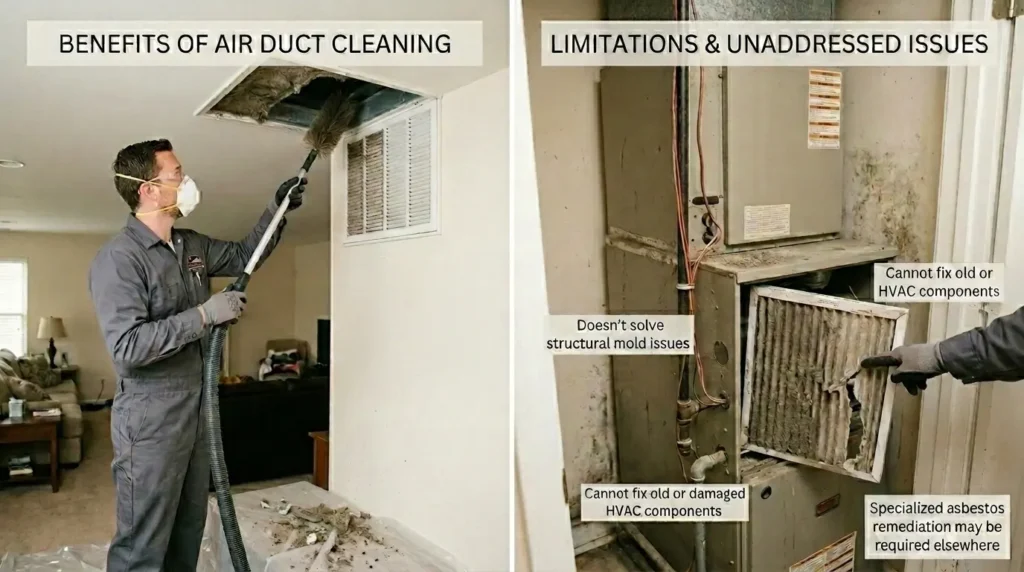
The main air duct cleaning benefits are straightforward when a duct system has a real contamination problem: professional cleaning can remove excessive dust, construction debris, pest-related material, and other loose contamination from accessible HVAC components. It can also leave registers, supply ducts, return ducts, and other cleaned areas visibly cleaner.
But duct cleaning cannot fix every HVAC or indoor-air problem. It does not guarantee lower energy bills, better health, stronger airflow, or permanent odor removal. Those results depend on the actual cause of the problem. The EPA recommends air duct cleaning as needed rather than as routine maintenance.
Understanding both the benefits of duct cleaning and its limits makes it easier to decide what the service can realistically accomplish.
What Does Air Duct Cleaning Actually Do?
Professional duct cleaning is mainly a source-removal process.
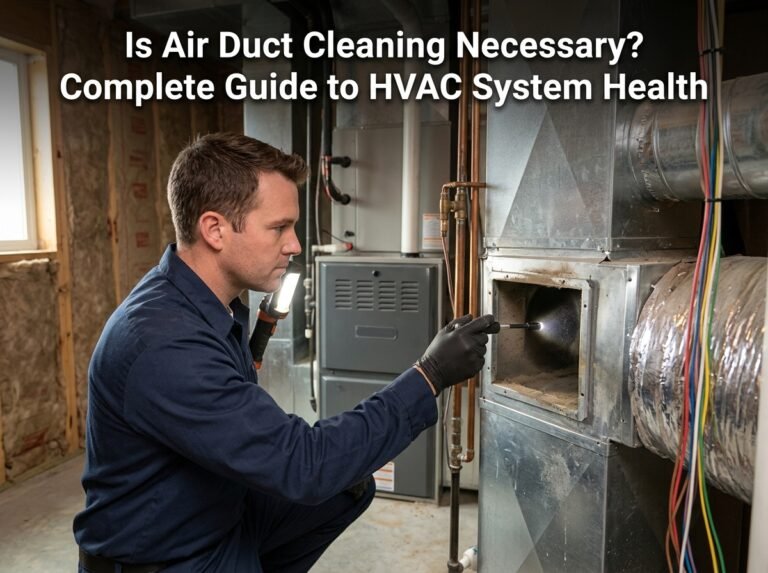
Dust and debris can settle on duct surfaces and other HVAC components over time. When cleaning is justified, professional equipment is used to loosen this material and collect it rather than simply wiping the visible face of a register.
NADCA describes proper HVAC cleaning as having two key parts: breaking contaminants loose and collecting those contaminants. It also recommends considering the connected HVAC system rather than treating only one small section of ductwork.
Depending on the agreed scope, cleaning can involve supply ducts, return ducts, registers, grilles, plenums, blower components, coils, and other accessible parts of the system.
That gives us the clearest answer to what does duct cleaning do: it physically removes accessible contamination from the HVAC system.
When Are Air Duct Cleaning Benefits Most Realistic?
The strongest case for duct cleaning is when there is something meaningful to remove.
A small amount of ordinary household dust is not the same as a duct that contains heavy debris. EPA guidance says duct cleaning should be considered when ducts are clogged with excessive dust or debris, when particles are being released from supply registers, when there is vermin infestation, or when substantial biological growth has been properly identified.
Situations where cleaning may provide a practical benefit include:
- Significant visible debris inside accessible ductwork
- Construction or renovation material that entered the system
- Pest-related debris after the pest problem has been corrected
- Heavy dust accumulation that is actually restricting a duct section
- Contamination affecting connected HVAC components that are included in the cleaning
- Material being released from supply registers
The benefit in these cases is not theoretical. There is an identifiable source inside the system that can be removed.
Can Air Duct Cleaning Remove Dust and Debris?
Yes, removing dust and debris is one of the most direct air duct cleaning benefits when meaningful buildup is present.
Professional source-removal cleaning uses agitation tools to loosen contamination from internal surfaces while collection equipment removes the released material.
NADCA says continuous negative pressure is used during cleaning to collect loosened particles and keep them from spreading through the occupied space.
This is different from cleaning the visible vent cover.
A dusty register can often be cleaned on its own. If debris extends into supply ducts, return ducts, trunk lines, or other components, a larger system-cleaning process may be needed.
The important distinction is the location and amount of contamination.
Does Duct Cleaning Leave the HVAC System Cleaner?
When the system contains removable contamination and the work is performed correctly, visibly cleaner HVAC surfaces are a realistic outcome.
EPA guidance recommends a visual inspection after cleaning and states that accessible portions of the system should be free of visible debris after a thorough job.
That can include duct interiors, registers, grilles, plenums, and included HVAC components.
NADCA also warns that cleaning only part of a contaminated system can allow other dirty components to recontaminate areas that have already been cleaned.
For this reason, the scope of the job matters.
A service that only vacuums around room registers should not be presented as equivalent to cleaning the affected HVAC system.
Can Air Duct Cleaning Improve Airflow?
Sometimes, but only when debris is actually contributing to an obstruction.
If a duct contains a large accumulation of material that restricts the air path, removing that material may help restore the open space inside that section.
However, poor airflow has many possible causes that duct cleaning cannot correct.
Examples include a clogged filter, damaged ductwork, disconnected ducts, closed dampers, duct leakage, an HVAC equipment problem, poor system design, or an incorrectly sized system.
This is an important limitation when considering air duct cleaning pros and cons.
Do not assume that weak airflow means dirty ducts.
The cause should be identified before deciding that cleaning is the solution. If the problem is mechanical or structural, an HVAC repair may be needed instead.
Does Air Duct Cleaning Improve HVAC Efficiency?
Cleaning ducts alone should not be sold as a guaranteed energy-saving service.
EPA says some research suggests that cleaning dirty HVAC components such as cooling coils, fans, and heat exchangers may improve system efficiency. However, it also states that there is little evidence that cleaning only the ducts will improve HVAC efficiency.
That distinction matters.
A system with a dirty coil or another affected mechanical component is not the same problem as ordinary dust sitting on a duct surface.
If high utility bills or poor system performance are the main concern, duct cleaning should not replace a proper HVAC inspection.
Problems such as duct leakage, equipment condition, insulation, filter restriction, or system sizing may require different work.
Does Air Duct Cleaning Improve Indoor Air Quality?
The answer is not guaranteed.
Duct cleaning can remove material that is physically present inside a contaminated HVAC system. But that does not mean every home will experience a measurable change in indoor particle levels after cleaning.
EPA states that studies have not conclusively shown that household particle levels increase simply because air ducts are dirty or that those levels fall after duct cleaning. Much of the dust inside ducts can remain attached to internal surfaces rather than entering living areas.
Indoor particles can also come from many other sources, including outdoor air, cooking, cleaning, pets, fabrics, flooring, and normal household activity.
This is why duct cleaning should address a known system condition rather than being presented as a complete solution for indoor air quality.
What About Allergy or Asthma Relief?
Duct cleaning should not be described as a medical treatment.
The EPA says duct cleaning has not been shown to prevent health problems and warns against broad health claims from duct-cleaning providers.
A contaminated HVAC system can contain dust and other particles, and cleaning can remove those materials from the system when they are present. That is different from promising that a person’s symptoms will improve.
Health concerns involve many possible indoor and medical factors.
The evidence and limitations around that subject are covered separately in Steamrite’s air duct cleaning and allergy guide, rather than treating symptom relief as a guaranteed benefit of duct cleaning.
Can Duct Cleaning Solve a Moisture Problem?
No. Cleaning does not repair the cause of unwanted moisture.
Moisture can enter an HVAC system because of leaks, condensation, drainage problems, damaged insulation, installation issues, or other conditions.
If the source remains, cleaning the affected area may provide only a temporary result.
EPA guidance says moisture control is one of the most important steps in preventing biological growth in duct systems. It recommends correcting leaks, standing water, drainage problems, and other moisture sources.
This is a critical limitation.
When moisture is present, the order should be to identify the cause, correct the underlying problem, and then determine which HVAC components can be cleaned and which may require repair or replacement.
Is Air Duct Cleaning the Same as Mold Remediation?
No.
Duct cleaning and mold remediation should not be treated as interchangeable services.
A dark spot or dirty duct surface cannot automatically be identified as mold by appearance alone. EPA notes that a substance that looks like mold may require expert evaluation or laboratory analysis for positive identification.
Material type matters too. EPA states that wet or mold-contaminated fiberglass duct material may need replacement rather than ordinary cleaning. It also emphasizes that the condition causing moisture must be corrected or biological growth can return.
Homeowners dealing specifically with suspected contamination can read the separate mold in air ducts guide instead of assuming standard duct cleaning solves every moisture-related problem.
Can Duct Cleaning Remove Odors?
It can help when removable material inside the HVAC system is actually the source of the odor.
For example, if debris or another source inside accessible ductwork is producing an odor, removing the source may improve that condition.
But odors can also come from outside the ducts.
Possible sources include moisture problems, drains, carpets, pets, smoke residue, building materials, HVAC mechanical issues, or other parts of the home.
An odor that appears when the system runs may justify inspection, but it does not prove that duct cleaning alone will fix it.
The source must be identified first.
Masking an odor is also different from physically removing its cause.
What Air Duct Cleaning Cannot Repair
Cleaning removes contamination. It does not repair damaged equipment.
If an inspection finds leaking duct joints, torn flexible duct, damaged insulation, standing water, a clogged condensate drain, a failing blower, or another mechanical problem, those conditions require appropriate HVAC repair.
The same applies to system-design problems.
Cleaning cannot resize ductwork, balance an incorrectly designed system, repair an air leak, replace damaged insulation, or correct poor equipment sizing.
This is why a responsible answer to does air duct cleaning help always starts with identifying the problem.
If the cause is debris, cleaning may be the right service. If the cause is damage, moisture, or mechanical failure, something else needs to be corrected.
Is a Little Dust Inside Air Ducts a Problem?
Not necessarily.
EPA states that a light amount of household dust in ducts is normal and does not recommend cleaning ducts routinely just because some dust exists.
Return grilles can also collect visible dust because air is drawn through them.
A dusty grille does not automatically mean that the entire HVAC system contains heavy deposits.
This is where inspection provides more value than assumption.
Look at the system condition and the reason you are considering cleaning. Significant debris, a contamination event, or a known problem creates a different situation from a thin layer of normal household dust.
Cleaning should solve a real condition rather than simply respond to the fact that ducts are not perfectly spotless.
Why Does the Source of Contamination Matter?
Because cleaning without fixing the source can allow the same problem to return.
EPA says that when serious contamination exists, underlying causes should be corrected before cleaning or replacing ducts.
For example, if debris entered during remodeling, the dusty work should be finished before cleaning. If pests entered the duct system, the pest problem and entry points need attention. If moisture is involved, the leak, condensation, or drainage problem needs to be corrected.
This source-first approach gives duct cleaning a clear purpose.
The service removes existing contamination after the condition that created it has been stopped.
Otherwise, a freshly cleaned system may simply become contaminated again.
What Does Proper Cleaning Have to Do With the Benefits?
The quality and scope of the cleaning affect what the service can accomplish.
NADCA describes professional source removal as loosening contamination and collecting it under negative pressure. It also recommends cleaning the affected HVAC system rather than leaving contaminated components untreated.
Steamrite’s air duct cleaning in Aurora, CO states that its process uses professional-grade vacuum extraction equipment, specialized brushing tools, and a system inspection before cleaning.
The purpose of those steps is physical removal of material.
They should not be turned into promises about health, energy savings, or HVAC lifespan that cannot be guaranteed from duct cleaning alone.
Air Duct Cleaning Benefits for Aurora Homes
For Aurora homeowners, the same evidence-based rule applies: inspect the system and identify a real reason for cleaning.
Recent remodeling may introduce drywall dust or construction debris. Pest activity can leave material behind after the infestation is corrected. A system may also contain significant visible debris that needs source removal.
Those are practical conditions.
By contrast, an Aurora address, changing season, older home, or ordinary dust around a return grille does not by itself prove that duct cleaning is needed.
The benefits of duct cleaning are strongest when there is a clear problem inside the HVAC system and cleaning directly addresses that problem.
Final Thoughts
The most realistic air duct cleaning benefits come from source removal.
When an HVAC system contains excessive dust, construction debris, pest-related material, or another removable contaminant, professional cleaning can remove that material and leave affected components visibly cleaner.
The limitations are equally important. Duct cleaning does not guarantee better health, lower utility bills, stronger airflow, or a permanent solution to moisture and contamination problems. Those outcomes depend on what caused the problem in the first place.
If visible debris or another confirmed condition is present inside the HVAC system, professional air duct cleaning in Aurora, CO can address the removable material after any underlying source has been corrected.
FAQs
What are the main benefits of air duct cleaning?
The main air duct cleaning benefits are removing significant dust, debris, and other removable contamination from affected HVAC components and leaving cleaned areas visibly cleaner.
Does air duct cleaning really help?
Yes, when there is a real source-removal problem. If ducts contain excessive debris or contamination, cleaning can remove it. It is less useful when the problem is actually caused by damaged ductwork, moisture, HVAC equipment, or another source.
Does air duct cleaning improve airflow?
It may help if excessive debris is physically restricting a duct. It will not fix airflow problems caused by duct leaks, closed dampers, equipment failure, poor system design, or other mechanical issues.
Does duct cleaning lower energy bills?
It should not be guaranteed. EPA says there is little evidence that cleaning ducts alone improves HVAC efficiency, although cleaning certain dirty HVAC components may help system performance in some situations.
Does duct cleaning improve indoor air quality?
Cleaning can remove contaminants from a dirty HVAC system, but EPA says research has not conclusively shown that duct cleaning reduces household particle levels in every home.
Does air duct cleaning remove mold?
Standard duct cleaning should not automatically be treated as mold remediation. Suspected growth needs proper evaluation, moisture sources must be corrected, and some contaminated duct materials may require replacement.
Does every dusty duct system need cleaning?
No. EPA says a light amount of household dust inside ducts is normal and recommends duct cleaning on an as-needed basis.
What problems cannot be fixed by duct cleaning?
Duct cleaning cannot repair leaks, damaged ducts, wet insulation, drainage problems, equipment faults, system-design issues, or other mechanical problems. Those conditions need the appropriate repair.