

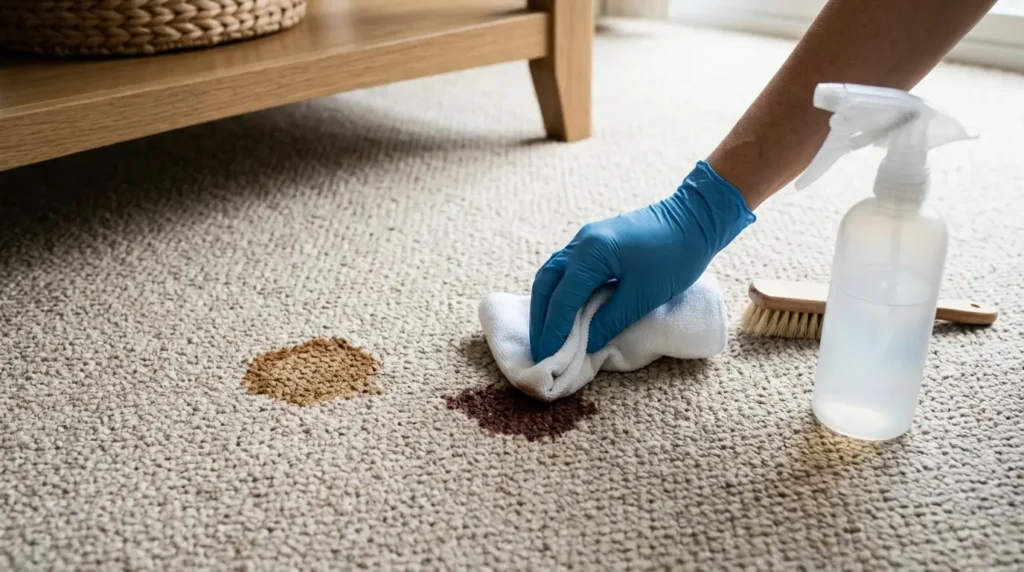
For safer carpet stain removal, act quickly, absorb as much of the spill as possible, and blot instead of rubbing. Use a clean white absorbent cloth so dye does not transfer to the carpet. Before applying any spot cleaner, test it in a hidden area for color or texture changes. The Carpet and Rug Institute also advises working gently from the outside of a spot toward the center and removing cleaning-product residue after treatment.
The right treatment depends on what caused the stain and what type of carpet you have. Coffee, wine, grease, mud, ink, and pet accidents should not all be treated with one universal homemade mixture.
What Should You Do First When Something Spills on Carpet?
The first few minutes can make later carpet spot cleaning easier.
For a liquid spill, place a clean white absorbent cloth or plain white paper towel over the area and blot. Continue using clean sections of the cloth as the liquid transfers.
Do not scrub.
CRI warns that aggressive brushing or scrubbing can damage carpet texture and cause fraying.
For thicker food or other semi-solid material, carefully lift away as much as possible before introducing a cleaning solution. Dry solid material should normally be removed first rather than immediately made wet. CRI’s spot-removal guidance follows this same basic approach.
A good first-response sequence is:
- Remove solids carefully.
- Blot liquids.
- Identify what caused the stain.
- Check the carpet care instructions.
- Test any cleaner in a hidden area.
- Treat with a suitable product.
- Remove remaining product as directed.
- Blot excess moisture.
This gives you a much safer starting point than reaching for the strongest cleaner in the house.
Why Should You Blot Instead of Rub?
Rubbing can spread the spill across a larger area and disturb the carpet pile.
Blotting uses pressure to transfer liquid from the carpet into an absorbent cloth without aggressive movement across the fibers.
CRI advises applying spot treatment to a white cloth and working gently from the outer edge toward the center. This can help limit spreading while the stain transfers into the cloth.
Use patience.
If material is still transferring to the cloth, repeat the blotting process rather than immediately switching to stronger chemicals.
A stain that takes several controlled passes is usually better than one aggressive attempt that changes the carpet texture or color.
Always Test a Carpet Cleaner Before Treating the Stain
Even a product sold for carpet should be tested before it is used on a visible area.
Carpets differ in fiber, dye, construction, backing, previous treatments, and stain-resistant finishes.
CRI advises pretesting spot-removal products in an inconspicuous area and checking for color transfer or damage before continuing.
Stop if the test causes:
- Color transfer
- Fading
- Texture change
- Bleaching
- Unusual stiffness
- Visible fiber damage
This is especially important when you do not know whether the carpet is nylon, polyester, wool, or another material.
Manufacturer care instructions should take priority over a generic internet cleaning recipe.
How Do You Remove Coffee or Tea Stains From Carpet?
With a fresh coffee or tea spill, start by absorbing as much liquid as possible.
Use a clean white cloth and blot from the outside toward the center.
Do not flood the spot with cleaner.
After removing excess liquid, use a carpet-safe spot treatment that is compatible with the carpet and follow its directions. Test the product first.
If the drink contained milk, cream, sugar, or flavoring, remember that the stain is no longer only coffee or tea. Added ingredients can leave additional residue in the carpet.
After treatment, remove remaining cleaning product according to its instructions. CRI warns that spot-cleaning residues can attract soil if they are left in the carpet.
If the spot remains after careful treatment, avoid repeatedly soaking it with different products.
How Should You Handle Red Wine on Carpet?
For wine, speed and controlled blotting are important.
CRI’s wine guidance begins with absorbing the spill using a dry white cloth or white paper towel. It also advises testing any treatment in a hidden location, working gently rather than rubbing, and removing remaining cleaning product after the spill has been treated.
For how to remove carpet stains caused by wine:
- Blot fresh liquid first.
- Do not scrub.
- Do not spread the spill outward.
- Test the selected carpet cleaner.
- Use only the amount directed.
- Continue blotting while the stain transfers.
- Remove cleaner residue afterward.
Do not assume that salt, baking soda, vinegar, detergent, or another household ingredient is automatically safe for every carpet.
CRI does publish specific spot procedures for some stains, but treatment varies by stain type and should still be compatible with the carpet.
What Should You Do With Grease and Oil Stains?
Grease behaves differently from a water-based drink spill.
That means the product used for coffee may not be the right choice for an oily stain.
First remove any solid or semi-solid material carefully without pressing it further into the carpet.
Then identify a carpet spot remover intended for greasy or oily soil and check the carpet manufacturer’s care guidance.
CRI’s guidance for greasy food stains again stresses pretesting, gentle treatment, blotting instead of rubbing, and residue removal.
Be especially careful with solvents.
CRI warns that solvent products should not be poured directly onto carpet or allowed to reach the backing because they can affect materials that hold carpet layers together.
If an oily stain requires a solvent treatment you are not comfortable using, that is a sensible point to stop home treatment.
Should Mud Be Cleaned While It Is Wet?
Mud is different from a drink spill because much of it is solid soil mixed with moisture.
Avoid spreading wet mud deeper across a larger area.
Remove what can be safely lifted without grinding it into the carpet. Once dry soil is present, vacuuming can remove loose particles before spot treatment begins.
CRI advises vacuuming dry spills before introducing liquid because adding moisture to dry material can create additional problems.
After loose soil has been removed, assess what remains.
A remaining discoloration can then be treated as a spot using an appropriate carpet-safe product.
This two-stage approach makes more sense than immediately soaking a muddy area with cleaner.
How Should Food Spills Be Treated?
Food spills vary too much for one cleaning formula.
Sauce, chocolate, cooking oil, fruit, dairy products, and sugary drinks can leave very different material behind.
Start by lifting any solid or semi-solid food with a spoon or another dull tool. Avoid pushing it deeper into the fibers.
Then blot remaining moisture.
For greasy food stains, CRI recommends the same core principles used throughout its spot-removal guidance: pretest the treatment, work gently, avoid rubbing, and remove remaining product so residue does not attract new soil.
When you do not know what a food product contains, treat it cautiously.
An oily sauce can require a different approach from a clear sugary drink even when both appear as similar dark spots on carpet.
What About Ink Stains?
Ink can be difficult because different inks contain different dyes, solvents, and binders.
Do not aggressively rub an ink spot. That can spread color across a larger area.
CRI maintains separate procedures for several types of ink rather than treating all ink as one stain category. Its permanent-ink guidance still begins with quick action, pretesting, gentle blotting, and controlled treatment.
This is a useful example of why a universal carpet recipe is risky.
If you do not know what type of ink caused the stain, be cautious with solvent products. CRI also warns that solvents should not be poured directly into carpet because they can reach and affect the backing.
If the stain spreads, transfers carpet dye, or does not respond to controlled treatment, stop before causing more damage.
Why Do Old Carpet Stains Become Harder to Treat?
Old carpet stain removal can be more difficult because time changes the situation.
The original spill may have dried, bonded with the fibers, collected additional soil, or already been treated with several cleaning products.
You may also be looking at something that is no longer removable soil.
For example, an old mark can involve:
- Permanent dye change
- Fiber damage
- Cleaning-product residue
- Re-soiling
- Material below the carpet surface
- A stain that has already been chemically altered
CRI repeatedly advises acting quickly because delays can allow some spills to become permanent stains.
That does not mean every old stain is permanent. It means expectations should become more cautious as the history of the spot becomes less clear.
Why Does a Carpet Stain Sometimes Come Back?
A stain that appears again after cleaning is often described as wicking.
The visible surface can look better while moisture or remaining material is still deeper in the carpet. As the carpet dries, some of that material can move toward the surface and become visible again.
Residue can create a different problem.
CRI warns that spot-removal products left in carpet can attract soil, causing the treated area to become dirty again faster.
If a spot returns, ask which pattern you are seeing:
- Did the original color of the spill come back?
- Did the area simply become dark with new soil?
- Was the carpet heavily wet during treatment?
- Was cleaning product fully removed?
- Has the same area been treated several times?
Understanding the pattern is more useful than automatically applying another round of cleaner.
Does Carpet Fiber Change How a Stain Should Be Treated?
Yes. Carpet is not one universal material.
Nylon, polyester, wool, and other carpet fibers can differ in how they respond to moisture, heat, chemicals, and stains.
The safest approach is to identify the carpet where possible and follow its manufacturer care instructions.
Even products tested for carpet should still be spot-tested before use. CRI specifically recommends testing a cleaner on a hidden part of the carpet before treating the visible stain.
This is why this stain removal guide does not give one homemade recipe for every stain and fiber.
A mixture that appears harmless on one carpet may not be suitable for another.
How Much Cleaning Solution Should You Use?
More is not better.
Too much product can make the carpet harder to rinse and can leave residue behind.
CRI advises following product directions and using a small amount during spot treatment. It also notes that remaining cleaning solution can attract soil if it is not adequately removed.
Avoid pouring cleaner directly over a large area unless the product instructions specifically require that type of application.
For normal spot treatment, controlled application gives you more control over:
- Moisture
- Spreading
- Residue
- Drying
- Carpet backing exposure
If you keep adding more product because the stain is not moving, stop and reassess the stain rather than continuing to saturate the carpet.
What About Pet Urine Stains?
Pet urine needs only a short section in a general stain guide because it can become a deeper contamination problem rather than a normal surface spot.
For a fresh accident, absorb as much liquid as possible without rubbing.
If urine has reached the carpet backing or padding, normal carpet stain removal may not address the full problem.
Steamrite’s dog urine smell removal guide covers urine-specific odor and contamination in more detail.
The important point here is not to treat every pet accident like coffee or food.
Urine can involve both visible staining and odor below the carpet surface, so repeated surface treatment may not solve the actual source.
When Should You Stop DIY Carpet Stain Removal?
Stop home treatment when you are no longer making safe progress.
That includes situations where:
- Carpet color transfers to your cloth
- The spot becomes lighter than the surrounding carpet
- The stain spreads
- Carpet texture changes
- Several products have already failed
- You do not know what product was previously used
- A solvent treatment is required and you are unsure how to use it
- The stain may extend below the carpet
- The carpet is delicate or manufacturer guidance is unclear
- The stain improves but repeatedly returns
CRI’s spot-removal pages regularly advise considering professional help for stubborn stains that do not respond to controlled treatment.
For stains that have moved beyond safe home spot care, professional carpet cleaning in Aurora, CO can address the carpet as part of a broader cleaning assessment.
Quick Guide to Common Carpet Stains
| Stain Type | Safer First Step | Main Risk to Avoid |
| Coffee or tea | Blot fresh liquid quickly | Scrubbing or leaving residue |
| Red wine | Blot with a white absorbent cloth | Spreading the stain outward |
| Grease or oil | Remove solids and use compatible treatment | Pouring strong solvent into carpet |
| Mud | Remove loose dry soil first | Turning more dry soil into wet soil |
| Food | Lift solids, then blot | Grinding food deeper into fibers |
| Ink | Blot carefully and identify ink type | Spreading dye or overusing solvent |
| Old stain | Identify previous treatments first | Repeated chemical experimentation |
| Pet accident | Absorb fresh liquid | Ignoring deeper contamination |
The table is a starting point, not a substitute for carpet-specific care instructions.
Final Thoughts
Successful carpet stain removal starts with identifying the problem before choosing the product.
Blot fresh spills instead of rubbing them. Remove solids before adding moisture. Use a white absorbent cloth, test cleaners in a hidden area, and pay attention to carpet fiber and manufacturer instructions. Coffee, wine, grease, mud, food, ink, old stains, and pet accidents should not all be treated with the same formula.
The other important part of how to remove carpet stains is knowing when to stop. Repeated chemical treatment, excessive moisture, and scrubbing can create new problems without removing the original stain.
When careful carpet spot cleaning is no longer improving the area safely, contact Steamrite about carpet stain removal with details about the stain, carpet, and any products already used.
FAQs
What is the safest first step for carpet stain removal?
For most fresh liquid spills, blot with a clean white absorbent cloth instead of rubbing. Remove solids carefully, identify the stain, and test any cleaning product in a hidden area before treating the visible spot.
Should I rub a stain to remove it faster?
No. CRI warns that scrubbing can damage carpet fibers and alter texture. Blotting is the safer first approach.
Why should I use a white cloth?
A plain white cloth makes it easier to see material transferring from the carpet and avoids the risk of dye or print from a colored cloth moving onto damp carpet.
Can I use the same cleaner on every carpet stain?
No. Stains differ, and carpet materials can react differently to cleaning products. Test products first and follow carpet and product care instructions.
Why does a cleaned spot get dirty again?
Cleaning-product residue can attract soil if it remains in the carpet. CRI advises removing spot-treatment residue after cleaning.
Can every old carpet stain be removed?
No. Some old marks may involve permanent dye change, fiber damage, or a spill that has changed over time. Older stains should be approached with realistic expectations.
When should I call a professional for a carpet stain?
Consider professional assessment when the stain is spreading, carpet color changes, repeated treatments have failed, a solvent-based treatment is needed, the carpet is delicate, or the contamination may be below the carpet surface.