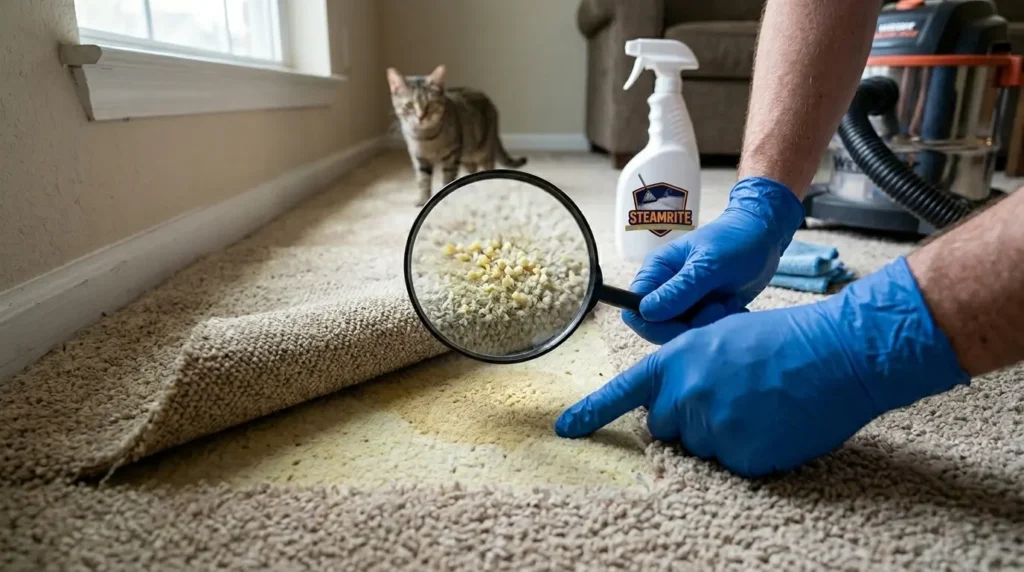
If pet urine smell comes back after cleaning, the most common reason is that some of the urine remains below the carpet surface. Liquid can pass through carpet fibers into the backing, padding, and sometimes the subfloor. Cleaning the visible spot may improve the surface while leaving the deeper odor source behind. Humidity can also make an old urine odor noticeable again. The Carpet and Rug Institute notes that complete odor removal is unlikely when urine has not been fully removed and that odor may reappear during periods of high humidity.
That is why a carpet can look clean and smell fine at first, yet develop the same odor again later.
The key question is not simply, “What cleaner should I use next?” It is, “Where is the remaining contamination?”
Why Can the Smell Return After the Carpet Looks Clean?
A carpet has several layers.
What you see and touch is only the face of the carpet. Beneath the carpet fibers are backing materials, followed by the carpet cushion or pad. Below that sits the floor surface or subfloor.
A liquid accident does not always remain in the visible carpet pile.
The Carpet and Rug Institute explains that urine can affect carpet backing and notes that some carpet constructions are specifically designed to help stop spills from reaching the cushion and possibly the subfloor. This means penetration below the surface is a real concern when urine is not contained quickly.
Steamrite also describes recurring odor as a problem that can occur when urine moves through the carpet into the padding or deeper materials.
Surface cleaning may therefore improve what you can see without reaching everything that originally absorbed the accident.
Surface Contamination vs. Subsurface Contamination
Understanding the difference between surface and subsurface contamination makes recurring pet urine smell easier to diagnose.
Surface contamination
The accident remains mainly in the carpet fibers near the surface.
A fresh, small accident that is addressed quickly may fall into this category.
Subsurface contamination
The liquid travels deeper into:
- Carpet backing
- Carpet pad
- Seams
- Flooring below the carpet
- Subfloor in more severe cases
When contamination reaches these layers, cleaning only the carpet face may leave part of the source untouched.
That is one reason the same spot can smell better immediately after cleaning and then begin to smell again.
Can Pet Urine Reach the Carpet Pad?
Yes.
Carpet is not a waterproof barrier unless its construction includes a backing specifically designed to resist liquid penetration.
CRI’s technical guidance notes that urine-related moisture can affect carpet backing and discusses carpet products designed to prevent spills from moving into the carpet cushion and possibly the subfloor.
The pad is especially important when trying to understand why does urine smell return.
If the visible carpet is cleaned but contaminated padding remains underneath it, the odor source has not necessarily been removed.
You may not be able to confirm the depth simply by looking at the carpet from above.
Can Pet Urine Reach the Subfloor?
It can when enough liquid passes through the carpet and pad.
The risk depends on the amount of urine, how often the same area has been used, carpet construction, how quickly the accident was addressed, and the materials below the carpet.
CRI identifies the subfloor as one of the deeper layers that spill-resistant carpet backing may help protect. Steamrite also lists subfloor contamination as a possibility in more severe or long-term pet-odor situations.
This matters because cleaning the carpet face cannot directly correct contamination that remains in a deeper building material.
A returning odor from the same location can therefore be a clue that the problem extends beyond the surface.
Why Can Humidity Make Urine Odor Noticeable Again?
Humidity can make an old pet-urine problem seem as if it suddenly returned.
The Carpet and Rug Institute specifically warns that pet urine odor may reappear during periods of high humidity when the original urine has not been completely removed.
This does not necessarily mean a pet had another accident.
It can mean residual contamination from an older accident is still present.
You may notice this pattern:
- The carpet is cleaned.
- The room smells better.
- Several days or weeks pass.
- Indoor conditions become more humid.
- The same area begins to smell again.
That pattern points back toward the original odor source rather than automatically proving that the recent carpet cleaning caused a new problem.
Is Uric Acid the Only Reason Pet Urine Odor Returns?
No. Pet urine is chemically more complicated than one compound.
Uric acid is present in mammalian urine, including dog and cat urine, but mammals generally excrete much more urea than uric acid. Research examining mammalian urine has identified uric acid among several urinary compounds.
For carpet troubleshooting, it is more accurate to think in terms of remaining urine residue and contamination depth rather than blaming every recurring smell on “uric acid crystals.”
Urine contains multiple compounds, and odor can also involve chemical changes that occur as urine remains on a surface. Scientific reviews of dog and cat urine note that urine contains many metabolic substances that can contribute to characteristic odors.
The practical issue remains the same: if part of the urine source remains in the carpet system, the odor can remain too.
Why Can the Smell Return After Professional Carpet Cleaning?
A normal carpet-cleaning appointment and a deep pet-urine treatment are not always the same service.
If the urine is limited mainly to the carpet fibers, normal cleaning may address much of the affected area.
If urine has reached the backing, pad, or another deeper layer, cleaning the carpet surface alone may not reach all of it.
This is why pet urine odor after carpet cleaning does not automatically mean the carpet was poorly cleaned.
The problem may have existed below the carpet before the appointment began.
A proper diagnosis needs to answer:
- Where was the accident?
- Was the same area used repeatedly?
- How large was the affected area?
- Did liquid reach beneath the carpet?
- Was the appointment normal carpet cleaning or urine-specific treatment?
- Does the odor return from one exact location or an entire room?
Those questions help separate a normal cleaning issue from deeper pet contamination.
Why Do Repeated Pet Accidents Create a Bigger Problem?
One small accident and repeated accidents in the same location are different situations.
When a pet repeatedly urinates in one area, new liquid can move through already affected carpet and into deeper layers.
The visible stain may still look small, while the area below the carpet can be larger.
Repeated marking is also possible. UC Davis School of Veterinary Medicine notes that dogs may return to previously marked locations to renew an olfactory mark.
For homeowners, this means a recurring smell should not automatically be treated as one old stain.
There may have been more than one accident in the same general area.
If the odor repeatedly returns from a location your pet continues to use, both the carpet contamination and the pet’s repeated behavior need to be considered separately.
Why Does Fragrance Not Solve Recurring Urine Odor?
A fragrance can change what you smell without removing what is causing the smell.
CRI warns that some odor products may simply mask pet urine odor. It states that complete odor removal is unlikely when the urine itself has not been completely removed.
This is why adding:
- Carpet deodorizer
- Strong fragrance
- Room spray
- Scented powder
- Air freshener
may make a room seem better for a short time but tell you little about whether the underlying contamination is gone.
If urine smell keeps coming back, repeatedly covering the smell can actually make troubleshooting harder because it becomes more difficult to identify the true source.
Source removal and odor masking are not the same thing.
Could Cleaning Product Residue Be Confused With Urine Odor?
Sometimes a carpet smells different after cleaning even when pet urine is not the only issue.
Excess moisture or cleaning-product residue may create another smell that a homeowner interprets as the original urine odor.
The location provides a useful clue.
If the smell comes from the exact area where a pet accident previously occurred, remaining pet contamination deserves attention.
If the smell appears across a much larger area after general cleaning, the cause may need to be evaluated more broadly.
Do not repeatedly add different household products just because the smell is hard to identify.
Mixing treatments can make later assessment more difficult and may not be suitable for the carpet fiber.
How Can You Tell if the Odor Is Coming From Below the Carpet?
You usually cannot confirm contamination depth from smell alone.
However, certain patterns can suggest that a deeper source is possible.
The smell returns from the same exact area
A repeated odor in one location may indicate that the original source remains there.
The visible stain is gone but the smell remains
Appearance and odor do not always come from the same layer.
The smell becomes stronger in humid conditions
CRI specifically identifies high humidity as a situation in which an unresolved pet-urine odor may reappear.
The pet used the area more than once
Repeated accidents increase the amount of liquid that may have entered the carpet system.
Home cleaning gives only temporary improvement
If several surface-cleaning attempts improve the smell briefly but it continues returning, further surface treatment may not be reaching the entire source.
These are clues, not proof. The actual depth of contamination can vary from one carpet to another.
Recurring Pet Urine Odor: A Simple Troubleshooting Guide
Use the pattern of the odor to decide what question to ask next.
| What You Notice | What It May Suggest | Next Question |
| Smell returned in the exact same spot | Original contamination may remain | Could urine have reached the backing or pad? |
| Smell increases during humid weather | Old urine residue may still be present | Was the original source fully removed? |
| Surface looks clean but smell remains | Odor source may be below visible fibers | Was only the carpet face treated? |
| Pet repeatedly used the same area | Contamination may be larger or deeper | How many accidents occurred there? |
| Fragrance hides the smell briefly | Odor is being masked | Where is the actual source? |
| Odor returns after normal carpet cleaning | Urine-specific treatment may not have been part of the service | Was pet contamination assessed separately? |
| Large area smells instead of one spot | More than one source may exist | Are there hidden or repeated accidents? |
The goal of this troubleshooting process is not to diagnose carpet layers with certainty from a checklist.
It is to stop treating every recurring odor as another surface stain.
What if the Accident Is Old and Completely Dry?
Old contamination is a separate problem from explaining why an odor returns.
Once an accident has been present for a long time, it may involve dried residue, repeated cleaning attempts, discoloration, or contamination below the carpet surface.
Rather than turning this article into another step-by-step removal guide, Steamrite’s dried pet urine smell removal resource covers older contamination as its own topic.
For recurring odor, the important point is simpler:
Dry does not always mean gone.
CRI notes that odor can reappear when urine has not been completely removed, particularly during periods of high humidity.
When Should You Stop Repeating Surface Cleaning?
Repeated surface cleaning makes less sense when the same pattern keeps happening.
Consider a deeper assessment when:
- The odor returns after the carpet dries
- The same location has been cleaned several times
- The pet used the area repeatedly
- The smell becomes stronger with humidity
- The stain is gone but the odor remains
- You suspect the carpet pad was affected
- A large amount of urine was involved
- More than one hidden accident may exist
At that point, the main question is contamination depth.
More surface cleaner does not necessarily provide more information about what is happening below the carpet.
What Happens When the Carpet Pad Is Contaminated?
The carpet pad sits below the visible carpet and can hold contamination that normal surface cleaning does not directly address.
If the affected area reaches the pad, treatment decisions depend on how much material is involved and the condition of the carpet system.
There is no responsible way to say from an article that every contaminated pad can be cleaned or that every pad must be replaced.
That decision requires knowing the actual condition.
Steamrite’s current service information states that its pet-odor process begins with inspection and that severe contamination may require a different response when deeper layers are involved.
The important point is to diagnose before making assumptions.
What if the Subfloor Is the Odor Source?
Subfloor involvement is a deeper contamination issue.
It should not be assumed simply because a room smells bad.
However, if repeated or heavy accidents have passed through carpet and padding, the surface below them may need to be considered.
Steamrite identifies subfloor contamination as a possibility in severe or long-term cases. CRI also recognizes that spills can reach the subfloor when carpet backing does not stop penetration.
Once the odor source is below the carpet system, ordinary surface cleaning is no longer addressing the same layer.
That is why finding the source matters more than repeatedly treating what you can see.
Does an Enzyme Cleaner Guarantee the Odor Will Not Return?
No single product should be treated as a universal guarantee.
CRI notes that enzyme-based pet treatments are available, but its main warning is broader: if the urine itself cannot be completely removed, complete odor removal is unlikely.
The treatment product is only one part of the situation.
Results can also depend on:
- Where the urine is located
- How deep it penetrated
- How many accidents occurred
- Carpet construction
- Padding condition
- Previous treatments
This article therefore does not treat enzyme products as a shortcut or guaranteed solution.
The source still needs to be reached.
When Does Professional Assessment Make Sense?
A deeper assessment makes sense when the problem no longer behaves like a simple surface accident.
Steamrite’s professional pet urine and odor removal in Aurora, CO is separate from ordinary carpet cleaning and is intended for pet contamination that needs source-focused treatment. Steamrite states that its process includes inspecting affected areas and addressing contamination according to its depth and location.
Professional assessment can be useful when you need to determine whether the problem appears to involve:
- Carpet fibers only
- Carpet backing
- Padding
- Multiple accident areas
- Upholstery layers
- A deeper flooring surface
The purpose of assessment is to identify what needs treatment rather than guessing from odor alone.
Final Thoughts
When pet urine smell comes back after cleaning, the most useful step is to stop thinking only about the visible stain and start thinking about the full carpet system.
Urine can move from the carpet fibers into the backing, pad, and sometimes deeper materials. A surface may therefore look clean while part of the original odor source remains. Humidity can also make unresolved urine odor noticeable again, something the Carpet and Rug Institute specifically warns about.
A recurring pet urine smell does not tell you exactly which layer is affected, but it does provide a reason to investigate the source rather than continually masking the odor.
When the same area continues smelling after normal cleaning, a Steamrite pet urine odor assessment can focus on the affected location and whether contamination appears to extend beyond the carpet surface.
FAQs
Why does pet urine smell come back after cleaning?
A pet urine smell comes back after cleaning when some of the original urine source remains. Urine may have moved below the carpet fibers into the backing, padding, or deeper material. CRI also notes that unresolved urine odor can reappear during high humidity.
Why does my carpet smell like urine again after it dries?
The visible carpet may have been cleaned while contamination remained deeper in the carpet system. As conditions change, the remaining odor can become noticeable again.
Can pet urine soak through carpet into the padding?
Yes. CRI discusses carpet backings designed to prevent spills from penetrating into the carpet cushion, which confirms that liquid can otherwise move into this deeper layer.
Can urine reach the subfloor?
It can in more severe situations when liquid passes through the carpet and padding. The amount of contamination and carpet construction affect how far it travels.
Why does pet urine smell stronger when it is humid?
CRI notes that pet urine odor may reappear during periods of high humidity when the original urine has not been completely removed.
Does a returning smell mean my carpet was cleaned incorrectly?
Not necessarily. The original contamination may have reached deeper layers that were outside the scope of normal surface carpet cleaning.
Can air freshener remove pet urine odor?
Air freshener may change or mask the smell but does not prove the urine source has been removed. CRI specifically warns that some odor products only mask pet urine odor.
How do I know whether urine reached the carpet pad?
You cannot confirm depth from smell alone. Repeated accidents, odor returning from one location, and temporary improvement after surface cleaning can suggest deeper contamination, but inspection may be needed to determine the actual condition.
Should I keep cleaning the same spot if the odor returns?
Repeated surface treatment may not help if the source is below the carpet. If the same smell repeatedly returns, finding the depth and location of the contamination becomes more important than adding another surface cleaner.