
The main steam carpet cleaning benefits are deeper soil removal, extraction of used cleaning solution, better control of residue, and the ability to clean soil that routine vacuuming may leave behind. The method commonly called steam cleaning is actually hot water extraction. It applies cleaning solution and water to the carpet, then uses an extractor to recover the water, solution, and loosened soil.
However, steam cleaning is not perfect for every carpet or every problem. Results depend on carpet fiber, soil level, stain type, cleaning products, extraction strength, and drying conditions. Understanding both the benefits and the limits helps you know what this cleaning method can realistically do.
What Is Steam Carpet Cleaning?
Steam carpet cleaning is the common name for hot water extraction.
Despite the word “steam,” the cleaning process does not normally depend on steam itself. Shaw describes hot water extraction as a system that applies a cleaning agent to the carpet pile and then uses water and extraction equipment to recover the used solution and soil.
A professional hot water extraction process may include pre-vacuuming, pre-treatment, agitation where needed, extraction passes, and additional dry passes. CRI-certified cleaning systems use variations of these stages depending on the equipment and carpet being cleaned.
The exact process should still match the carpet type, condition, and manufacturer care requirements.
What Are the Main Steam Carpet Cleaning Benefits?
The most important benefits of hot water extraction come from the combination of soil loosening and extraction.
Vacuuming is useful for regular dry soil removal, but periodic deeper cleaning is intended to address material that remains in the carpet after routine maintenance. The Carpet and Rug Institute recommends professional deep cleaning as part of proper carpet care and evaluates extractors for soil removal, appearance change, and residual moisture.
That creates several practical advantages when the method is used correctly.
It Removes Soil That Vacuuming May Leave Behind
Regular vacuuming should remain the first part of carpet maintenance, but some soil can settle deeper into the carpet pile.
High-traffic areas may also collect oily or sticky material that cannot be removed by dry vacuuming alone.
Hot water extraction introduces moisture and an appropriate cleaning solution to loosen this material. The extractor then recovers the used solution and suspended soil.
This is one of the main steam cleaning carpet advantages for periodic deeper cleaning. It works as a different stage of carpet care rather than replacing routine vacuuming.
CRI identifies deep cleaning as an important part of carpet maintenance for removing embedded dirt and grime.
The Process Removes Used Cleaning Solution
Cleaning carpet is not only about applying a product.
Whatever loosens the soil also needs to be removed.
With hot water extraction, the extractor pulls used cleaning solution, moisture, and loosened soil back out of the carpet. This is an important difference between properly completed extraction cleaning and simply adding more cleaner to a dirty area.
Shaw notes that some cleaning systems can leave residue that contributes to faster re-soiling. Its preferred hot water extraction process is designed to recover the used cleaning solution and soil.
This makes extraction quality just as important as the cleaning solution itself.
It Can Help Control Cleaning-Product Residue
Too much detergent or poorly removed cleaning solution can leave material in the carpet pile.
That residue may affect the feel of the carpet and can contribute to faster re-soiling.
One of the practical hot water extraction benefits is that the process is designed to rinse and recover material rather than leave the cleaning solution sitting in the carpet.
Good technique matters here.
The cleaner still needs to use a suitable amount of product, choose a solution that matches the carpet, and extract it properly. Using more chemical does not automatically create a better result.
Extraction Helps Control Moisture
Hot water extraction uses moisture, but a properly performed process also removes moisture.
The Carpet and Rug Institute tests approved extraction equipment not only for soil removal but also for residual moisture. That matters because the goal is to clean the carpet without leaving unnecessary water behind.
Professional extraction can include dry passes after the main cleaning passes to recover additional moisture. CRI-listed hot water extraction systems show both wet extraction and dry extraction passes as part of tested processes.
Drying still depends on room and carpet conditions, so moisture control should not be turned into a fixed drying-time promise.
It Works Well as Periodic Deep Cleaning
Hot water extraction is best understood as a deeper periodic cleaning method, not something that replaces normal carpet care.
Routine maintenance should still include vacuuming, fast attention to spills, and reducing the amount of outdoor soil brought inside.
The Carpet and Rug Institute recommends regular vacuuming alongside periodic professional deep cleaning.
A strong carpet maintenance routine can help control everyday soil between deeper cleaning appointments.
This combination usually makes more sense than waiting until a carpet becomes heavily soiled and then relying on one aggressive cleaning session.
Why Does Pre-Treatment Matter?
Not every part of a carpet has the same soil level.
A lightly used corner may need less attention than an entry path, staircase, or area near a sofa.
Pre-treatment can help loosen heavier soil before the extraction stage. CRI-listed professional systems often use pre-spray followed by agitation or dwell time before hot water extraction.
The product used should match the carpet and the type of soil being treated.
This is especially important with oily areas, food residue, traffic lanes, and older spots. Carpet fibers and dyes can respond differently to cleaning chemistry, so a universal product or mixture should not be assumed to work safely on every carpet.
What Are the Limitations of Steam Carpet Cleaning?
A balanced look at carpet steam cleaning pros and cons also needs to explain what the method cannot guarantee.
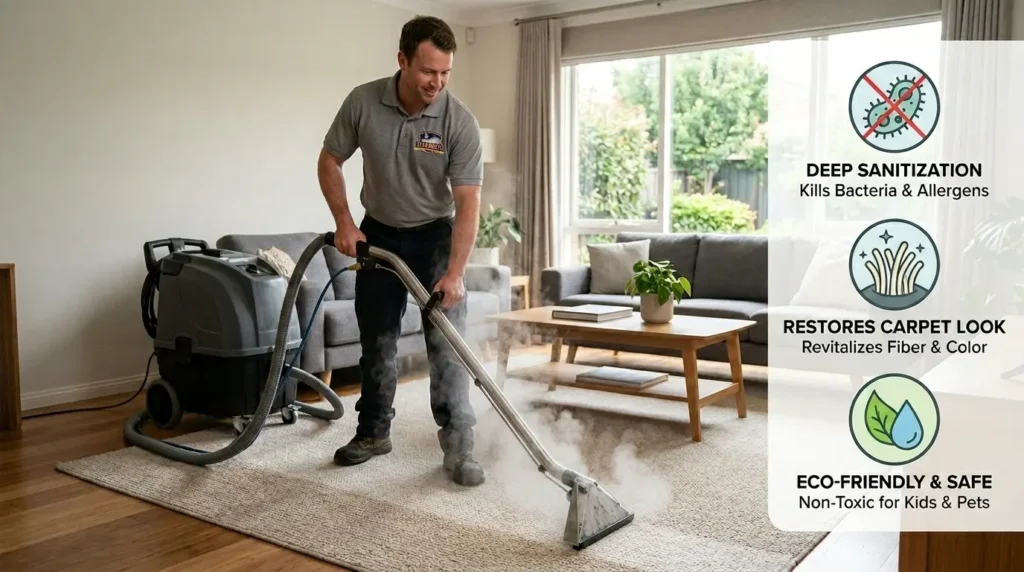
Hot water extraction can be a useful deep-cleaning method, but it is still a cleaning process. It cannot reverse permanent damage or solve every problem below the carpet.
Steam Cleaning Cannot Remove Every Stain
A stain may respond well to cleaning, improve only partly, or remain visible.
Results depend on factors such as the substance involved, how long it has been present, carpet fiber, dye, previous cleaning attempts, and whether the carpet has been permanently discolored.
Cleaning cannot restore dye that has been removed or repair damaged carpet fibers.
Pre-treatment may improve the chances of removing a spot, but no responsible carpet-cleaning article should promise that every stain will disappear.
It Cannot Repair Worn Carpet
Heavy traffic can change the physical appearance of carpet fibers.
An area may look dark because it is dirty, but it can also look different because the pile is worn, crushed, or damaged.
Cleaning may remove soil from that area without making damaged fibers look new again.
This is why carpet inspection matters before deeper cleaning begins. Soil and physical wear are different problems.
It Is Not Automatically the Right Method for Every Carpet
Carpet construction and manufacturer instructions matter.
Shaw recommends hot water extraction for its applicable carpet products and requires periodic hot water extraction under certain warranty conditions. That does not mean every carpet from every manufacturer should automatically receive the same heat, moisture, or cleaning chemistry.
Specialty fibers, delicate carpet, and certain constructions may need more controlled treatment.
The safest approach is to identify the carpet and follow its care requirements before choosing a deep-cleaning process.
Drying Time Is Not the Same for Every Job
There is no single drying time that applies to every steam-cleaned carpet.
Drying can be affected by carpet construction, the amount of moisture applied, extraction strength, number of dry passes, airflow, indoor temperature, humidity, and room conditions.
Strong moisture recovery can support faster drying, while excessive water or poor extraction can extend it.
The Carpet and Rug Institute includes residual-moisture testing when evaluating extraction equipment, which shows why moisture recovery is part of cleaning performance rather than an afterthought.
It Does Not Replace Proper Spot Treatment
A full extraction cleaning and a specific stain treatment are not always the same job.
Some stains need separate pre-treatment before the main cleaning stage. Pet urine that has reached carpet backing or padding may also require treatment beyond ordinary carpet extraction.
A carpet can be deeply cleaned while still having a separate contamination problem that needs another approach.
The cleaning plan should follow the actual source of the problem rather than assuming more hot water will solve everything.
Can Steam Cleaning Cause Re-Soiling?
The cleaning method itself should not automatically cause rapid re-soiling, but poor cleaning practices can contribute to it.
One possible cause is cleaning-product residue.
If too much detergent remains in the carpet, the affected fibers may attract new soil more quickly. Shaw specifically warns that some cleaning systems can leave residues that speed up re-soiling.
Proper extraction, suitable cleaning chemistry, and adequate rinsing help reduce this problem.
Re-soiling can also happen because normal traffic resumes, outdoor soil gets tracked back inside, or spills occur after cleaning. Good maintenance after the carpet dries is still important.
Is Steam Carpet Cleaning Good for High-Traffic Areas?
Hot water extraction can be useful when traffic areas contain embedded soil that regular vacuuming is no longer removing well.
Hallways, stairs, entrances, and common walking paths often collect more soil than lightly used parts of a room.
These sections may need pre-treatment before the main extraction stage.
However, cleaning should not be expected to repair traffic wear.
If fibers have been permanently crushed or worn, removing soil may improve cleanliness without completely restoring the original appearance.
This is another reason realistic expectations matter. A cleaning result should be judged by the amount of removable soil and staining addressed, not by whether old carpet suddenly looks unused.
Does Steam Cleaning Work on Pet Stains?
It can help with surface soil and some removable pet-related staining, but pet urine can become more complicated when it reaches below the carpet pile.
Contamination may move into the backing, padding, or material below the carpet. In that situation, normal carpet extraction may not reach the full source of the odor.
Pet urine should therefore be assessed separately when there is recurring odor or repeated contamination.
Steam cleaning should not be presented as a universal pet-odor cure.
The treatment needs to match the depth and type of contamination.
What Do These Benefits Mean for Aurora Homes?
For steam carpet cleaning in Aurora, CO, the same technical principles apply as they do elsewhere: the carpet should be inspected, suitable cleaning products should be selected, soil should be loosened, and as much used solution and moisture as practical should be extracted.
Local conditions can still affect how quickly carpet becomes soiled.
Aurora homes can deal with dry outdoor soil, changing weather, pets moving between indoor and outdoor areas, and busy entry paths. These conditions can make some parts of the carpet collect soil faster than others.
The answer is not to steam clean constantly. Routine vacuuming and entrance control should handle day-to-day soil, while deeper extraction can be used when the carpet condition calls for it.
While steam cleaning can be effective for many carpet concerns, homeowners looking for a more thorough solution can consider professional carpet cleaning in Aurora, CO.
The value of the method still depends on correct use, suitable carpet conditions, and effective extraction rather than simply using high heat or more cleaning solution.
How Is Hot Water Extraction Different From Choosing a Cleaning Method?
This article focuses on the steam carpet cleaning benefits and limitations of hot water extraction itself.
Choosing between different carpet-cleaning methods is a separate decision.
Different systems may use different amounts of moisture, cleaning chemistry, agitation, and extraction. A method should be evaluated based on carpet type, soil condition, manufacturer guidance, and the result you need.
If you are deciding between two cleaning approaches rather than evaluating hot water extraction on its own, the steam cleaning vs shampooing guide covers that comparison in more detail.
When Is Steam Carpet Cleaning a Good Choice?
Hot water extraction can make sense when a carpet needs periodic deeper cleaning and its manufacturer allows the method.
It may be useful when routine vacuuming no longer removes the visible soil, traffic areas need deeper attention, cleaning residue needs to be properly extracted, or the carpet has reached the point where normal maintenance is no longer enough.
The decision should still be based on carpet condition.
A lightly used room may not need the same level of cleaning as a busy family area. A permanently damaged carpet may need repair or replacement rather than repeated extraction.
The goal should be appropriate cleaning, not maximum cleaning.
Final Thoughts
The most useful steam carpet cleaning benefits come from what hot water extraction is designed to do: loosen embedded soil and then recover the used cleaning solution, moisture, and dirt from the carpet.
Good extraction can also help control residue and moisture, making the process useful for periodic deeper cleaning when the carpet is suitable for the method.
The limitations matter just as much. Steam cleaning cannot guarantee every stain will disappear, repair worn fibers, solve deep pet contamination automatically, or provide one fixed drying time for every home.
The best results come from matching the cleaning process to the carpet, using suitable products, controlling moisture, and extracting the carpet thoroughly.
FAQs
What are the main steam carpet cleaning benefits?
The main steam carpet cleaning benefits include deeper soil removal, extraction of used cleaning solution, better residue control, and the ability to address embedded soil that routine vacuuming may leave behind.
Is steam carpet cleaning actually steam?
Usually, the term refers to hot water extraction. Shaw explains that cleaning solution is applied to the carpet and water is used in an extractor to recover the solution and soil rather than relying on steam as the cleaning mechanism. Does steam cleaning leave detergent in the carpet?
A properly performed extraction process is designed to recover cleaning solution along with moisture and soil. Poor rinsing, excessive detergent, or weak extraction can leave more residue behind.
Can steam carpet cleaning remove every stain?
No. Stain results depend on the substance, carpet fiber, age of the stain, previous treatments, and whether permanent dye or fiber damage has occurred.
Does steam carpet cleaning dry quickly?
Drying time varies. Carpet construction, moisture level, extraction, airflow, temperature, and humidity all affect how quickly the carpet dries.
Is steam cleaning safe for every carpet?
Not automatically. Manufacturer care instructions and carpet construction should guide the method, cleaning chemistry, heat, and moisture used.
Can steam cleaning stop carpet from getting dirty again?
No cleaning process can stop future soil. Good extraction can help limit cleaning-product residue, but regular vacuuming, entrance mats, spill care, and routine maintenance are still needed.