

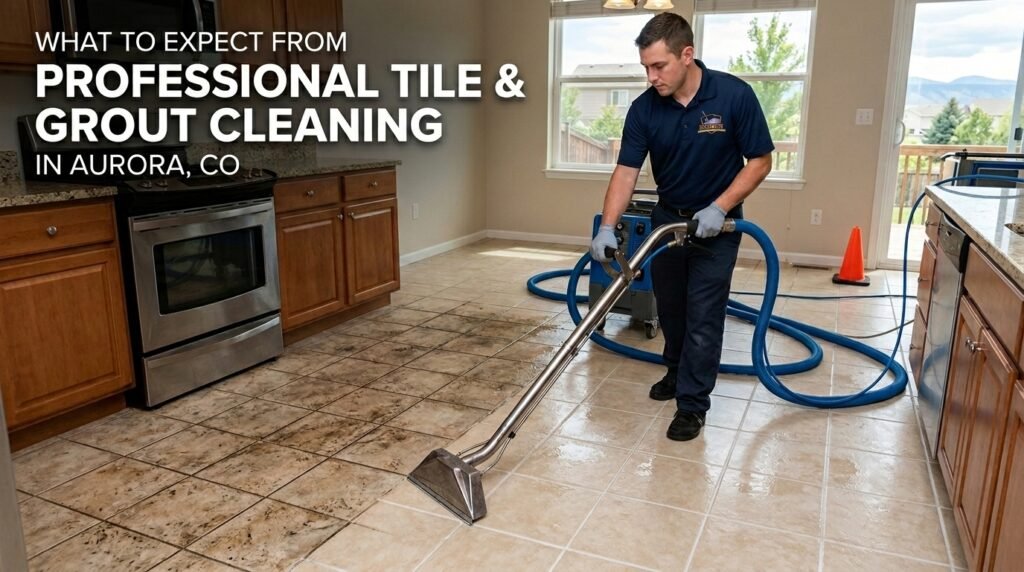
A professional tile and grout cleaning process usually begins with an inspection of the tile, grout joints, soil, stains, and problem areas. The technician then prepares the floor, chooses cleaning chemistry suited to the surface and soil, applies the cleaner, agitates dirty grout lines, and removes loosened soil with rinsing and extraction. The floor is checked again after cleaning, and the homeowner receives basic drying and aftercare instructions.
That is how professional grout cleaning works in simple terms. It is a controlled cleaning process, not just stronger mopping.
The exact steps can change because ceramic tile, porcelain tile, grout condition, soil type, previous cleaners, and surface damage do not all respond in the same way.
What Happens First During Professional Tile and Grout Cleaning?
Professional cleaning should start with inspection rather than immediately applying a chemical to the entire floor.
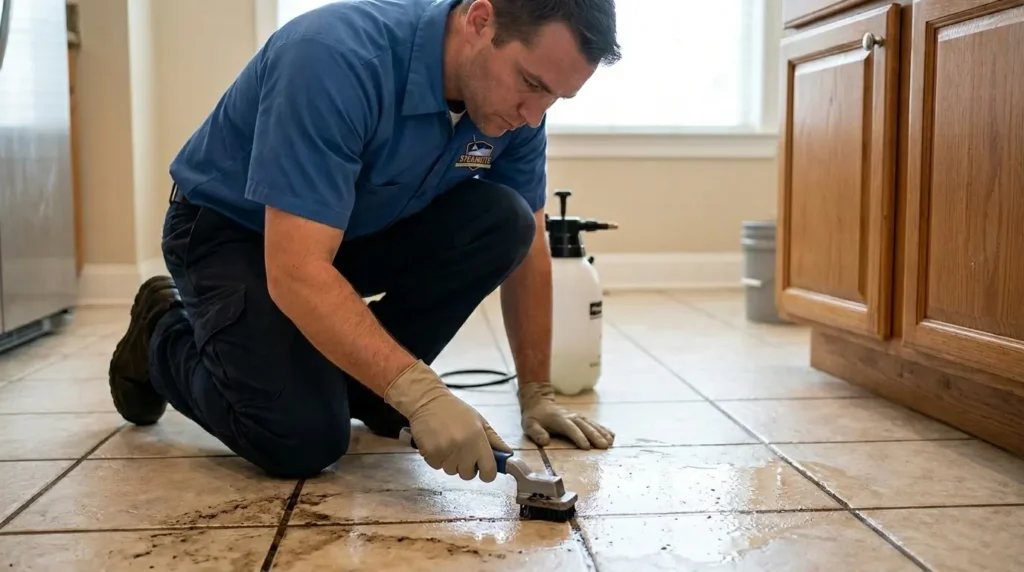
The technician first looks at the tiled area and identifies conditions that may affect cleaning. This can include the tile surface, grout joints, heavy traffic areas, sticky buildup, discoloration, grease, soap residue, damaged grout, and products previously used on the floor.
The inspection also helps separate removable soil from physical damage.
For example, cleaning may improve a dark grout joint if soil is causing the discoloration. It cannot rebuild missing grout, repair cracked tile, or reverse every permanent color change.
Steamrite lists a detailed inspection of tile and grout condition as the first stage of its professional tile and grout cleaning in Aurora, CO process.
Why Does the Type of Tile and Grout Matter?
Different surfaces can require different cleaning decisions.
Ceramic and porcelain tile are common in kitchens, bathrooms, entries, laundry rooms, and other areas, but the grout between those tiles can behave differently from the tile itself.
Traditional cement-based grout is porous and can absorb soil and stains. The Tile Council of North America explains that cementitious grout can absorb staining material and that cleaning products must be chosen with the grout material in mind.
The technician may also need to consider:
- Glazed or unglazed tile
- Cement-based grout
- Previous sealers
- Existing coatings
- Surface wear
- Cracked or missing grout
- Residue from household cleaners
- Areas exposed to grease or soap buildup
This is why one cleaner should not automatically be used on every tiled surface.
How Is the Soil Type Identified?
The appearance of the floor does not always reveal what is making it dirty.
Kitchen grout may contain cooking oils and tracked-in soil. Bathroom surfaces may have soap residue and mineral deposits. Entry areas can collect grit and outdoor dirt. Other rooms may have layers of cleaning-product residue that have built up over time.
Identifying the likely soil helps the technician choose a suitable cleaning approach.
A dark grout line does not automatically mean the same thing in every room.
The technician may look at where the discoloration appears, how the surface feels, the products previously used, and whether the grout changes during a small test area.
This step keeps the tile cleaning process focused on the actual condition instead of simply applying the strongest available product.
Why Is Cleaning Chemistry Important?
Cleaning chemistry should match the surface and the type of buildup being removed.
More aggressive chemistry is not automatically better.
The Tile Council of North America notes that cement-based grout is alkaline and can be damaged by inappropriate acid use. It also warns that oily or wax-based cleaners can leave films in grout and that cleaning residue that is not properly rinsed may attract more dirt.
That makes product selection important during professional cleaning.
A technician should consider the tile, grout, soil, previous treatments, and product directions before choosing the cleaner.
The purpose is to loosen contamination without creating an unnecessary risk to the grout joints or surrounding surfaces.
Is a Test Area Used Before Full Cleaning?
A small test area can be useful when the material, soil, previous treatment, or likely result is uncertain.
The technician can use the test area to see how the surface responds before applying the same process across a large floor.
A test may help answer questions such as:
- Does the soil release?
- Is the grout color changing because dirt is being removed?
- Is there a coating or residue on the surface?
- Does the cleaner affect the tile finish?
- Does an area require a different approach?
- Is the apparent discoloration actually permanent?
This also helps set expectations.
If a small section shows that the original grout color is much lighter beneath the soil, the larger cleaning may produce a noticeable change. If discoloration remains after soil is removed, cleaning may have reached its practical limit.
What Happens During Pre-Treatment?
Once the surface has been assessed, an appropriate cleaner may be applied to the areas being treated.
This stage allows the cleaning solution to begin loosening oily soil, grime, soap film, and other buildup before mechanical agitation and extraction.
The cleaner may need some contact time, often called dwell time, before the next stage begins.
Dwell time should follow the product and surface requirements rather than an arbitrary universal number.
The cleaner should also not be allowed to behave in a way that conflicts with its directions.
The purpose of pre-treatment is to make attached soil easier to remove. It is not to flood the floor with chemicals.
How Are Grout Lines Agitated?
Grout joints often need mechanical agitation because soil can settle into their textured, porous surface.
Professional agitation helps break up material that normal mopping may leave behind.
Steamrite states that its tile and grout cleaning process includes professional cleaning solutions followed by high-powered scrubbing and extraction.
The cleaning tool and pressure should match the condition of the floor.
Extra attention may be given to:
- Kitchen traffic lanes
- Entryways
- Areas around sinks
- Bathroom grout
- Edges
- Frequently walked paths
- Sections with heavier buildup
Agitation helps loosen soil, but the dirty material still needs to be removed afterward.
That is where rinsing and extraction become important.
Why Is Extraction Important in Tile and Grout Cleaning?
Loosening grime is only part of the job.
Once the cleaning solution and agitation have released soil, the dirty solution should be removed from the floor rather than spread into another grout joint or left to dry on the surface.
The Tile Council of North America specifically discusses vacuum extraction as an effective way to remove dirty cleaning water from grout. It also notes that cleaner residue can leave a film that attracts more soil if it is not properly removed.
Professional extraction helps recover:
- Loosened soil
- Dirty cleaning solution
- Rinse water
- Suspended residue
This is one of the main differences between simply moving dirty water around with a mop and completing a controlled cleaning process.
Does the Floor Need to Be Rinsed?
Proper rinsing can be an important part of the professional tile and grout cleaning process, especially when cleaning chemistry has been used to loosen buildup.
The purpose is to remove remaining soil and cleaning residue from the surface and grout joints.
Leaving excess cleaner behind can affect the way the floor feels and looks after drying.
TCNA notes that even suitable cleaners can leave a sticky film when they are not properly rinsed, and that this film can attract additional dirt.
Rinsing and extraction therefore work together.
The exact method can vary based on the floor, equipment, and cleaning chemistry, but the goal remains the same: remove the material that has been loosened rather than leaving it behind.
Can Professional Cleaning Remove Every Grout Stain?
No. Professional cleaning can remove soil and many forms of buildup, but it cannot guarantee that every discoloration will disappear.
Results depend on what caused the mark and what has happened to the grout over time.
A remaining dark or discolored area may involve:
- Deep staining
- Permanent grout discoloration
- Previous chemical damage
- Worn grout
- A coating or sealer
- Missing or damaged grout
- Material below or behind the tiled surface
Cleaning also cannot make damaged grout structurally new again.
This distinction matters during a grout cleaning appointment. The goal should be to remove cleanable contamination and reveal the actual condition of the surface, not promise that every grout joint will return to one exact shade.
What About Cracked or Missing Grout?
Cleaning does not repair damaged grout.
If the inspection finds cracked joints, loose sections, missing grout, broken tile, or another physical problem, cleaning may improve surrounding soil but will not correct the damage itself.
A damaged joint may need a separate repair.
It is useful to identify these areas before cleaning because a homeowner may otherwise expect a dark or irregular grout line to look completely restored once the soil is removed.
Cleaning and repair solve different problems.
A professional cleaning appointment should make that difference clear before the floor is treated.
Is Grout Sealing Part of the Cleaning Process?
Sealing is not the same step as cleaning.
Steamrite currently lists grout sealing as an optional part of its tile and grout service rather than something that must automatically be performed on every floor.
Whether sealing is appropriate can depend on the grout, tile assembly, existing treatment, and condition of the surface.
TCNA also notes that sealing decisions can depend on the grout and tile assembly rather than following one universal rule.
Cleaning should therefore be completed and the floor condition understood before any separate protective treatment is considered.
This guide focuses on cleaning, not on presenting sealing as a required add-on.
What Happens After Extraction Is Complete?
After the main cleaning and extraction stages, the floor should be checked again.
The technician can review areas that received extra attention and look for remaining soil, residue, discoloration, or damaged grout that is more visible now that the surface is clean.
Some sections may receive additional cleaning or extraction when appropriate.
A final inspection also allows the homeowner to see the difference between remaining damage and removable soil.
This is a useful time to ask about:
- Grout areas that remain discolored
- Existing cracks
- Drying
- When the floor can return to normal use
- Suitable routine cleaners
- Any areas requiring repair
The final check should explain the condition of the floor rather than simply ending when the cleaning equipment is put away.
How Long Does Tile and Grout Take to Dry?
There is no single drying time that applies to every tile and grout floor.
Drying can be affected by how much moisture was used, how much was recovered through extraction, grout porosity, indoor airflow, temperature, humidity, and the size of the cleaned area.
Tile surfaces may appear dry before porous grout joints have released all retained moisture.
For that reason, follow the instructions provided for the specific floor instead of relying on one fixed number of hours.
Keep unnecessary traffic off the cleaned area while it is still wet, and do not apply another product to damp grout unless its instructions specifically allow it.
What Should You Do After Professional Tile and Grout Cleaning?
Aftercare should be simple.
Allow the floor to dry as directed and avoid immediately covering it with new cleaning products or heavy soil.
Once the area is back in normal use, use cleaning products appropriate for the tile and grout rather than assuming stronger household chemicals will keep it cleaner.
Avoid products that leave oily, waxy, or sticky films in grout. TCNA notes that residue left by some cleaners can attract dirt and make clean grout soil faster.
Regular care after the appointment is separate from the deep-cleaning process itself.
Homeowners deciding between home cleaning and deeper equipment-based service can compare the two approaches in Steamrite’s professional tile and grout cleaning vs. DIY guide.
What Should Aurora Homeowners Expect During the Appointment?
For tile and grout cleaning in Aurora, CO, the process should be based on the actual floor rather than the city name.
Homes in Aurora can have tile in kitchens, bathrooms, entrances, laundry areas, and other heavily used spaces. Each location can collect a different type of soil.
An entry floor may contain tracked-in grit. Kitchen grout may hold oily soil. Bathroom tile may have a different type of buildup.
That is why a professional appointment begins with inspection.
The cleaning plan should match the material, grout condition, soil, and previous treatments found in that specific room.
Before the appointment, clear small items from the tiled area and point out any damaged grout, old stains, or products previously used on the floor.
What Questions Should You Ask Before Tile and Grout Cleaning?
A few practical questions can help you understand what will happen during the appointment:
- Which tiled areas are included?
- What type of tile and grout do I have?
- Are there damaged joints that cleaning cannot repair?
- How will heavy soil be treated?
- Will a test area be needed?
- How will loosened soil and cleaning solution be removed?
- What should I expect from existing grout discoloration?
- What should I do while the floor dries?
- Which type of cleaner should I use afterward?
- Is any optional treatment being discussed separately from cleaning?
These questions keep the conversation focused on the condition of your floor and the work being performed.
Final Thoughts
A professional tile and grout cleaning process should follow a logical sequence: inspect the floor, understand the tile and grout, identify the soil, select suitable chemistry, loosen the buildup, remove dirty solution, rinse or extract as needed, and check the surface after cleaning.
Good cleaning is not about using the strongest chemical or scrubbing every floor the same way. Ceramic tile, porcelain tile, grout joints, stains, residue, and physical damage can all change what the floor needs.
When built-up soil has moved beyond normal surface cleaning, professional tile and grout cleaning in Aurora, CO can address the removable buildup while keeping the cleaning process matched to the actual floor condition.
FAQs
What happens during professional tile and grout cleaning?
The professional tile and grout cleaning process generally includes inspection, surface and soil assessment, appropriate cleaner selection, pre-treatment, grout agitation, rinsing or extraction, a final check, and aftercare instructions.
How does professional grout cleaning work?
How professional grout cleaning works depends on the grout and soil. Cleaning chemistry loosens buildup, agitation helps release soil from grout joints, and extraction or rinsing removes the dirty solution.
Do professional cleaners use the same chemical on every tile floor?
No. Cleaner selection should depend on the surface, grout, soil, previous treatments, and product directions. More aggressive chemistry is not automatically better.
Can professional cleaning make every grout line the same color?
Not always. Some discoloration may be permanent or related to wear, previous chemicals, damaged grout, or conditions that cleaning cannot reverse.
Is grout sealing automatically included?
No. Cleaning and sealing are separate steps. Steamrite lists sealing as an optional service, and whether it is appropriate depends on the floor and grout condition.
Should I move everything before a grout cleaning appointment?
Clear small items that block access to the tiled floor. Heavy furniture or fixtures should be discussed before the appointment rather than moved without a plan.
Why is extraction used after scrubbing?
Extraction removes loosened soil, dirty cleaning solution, and rinse water instead of leaving that material on the floor or inside grout joints.
Can tile and grout cleaning repair cracked grout?
No. Cleaning removes soil and buildup. Cracked, loose, or missing grout is a physical repair issue.