

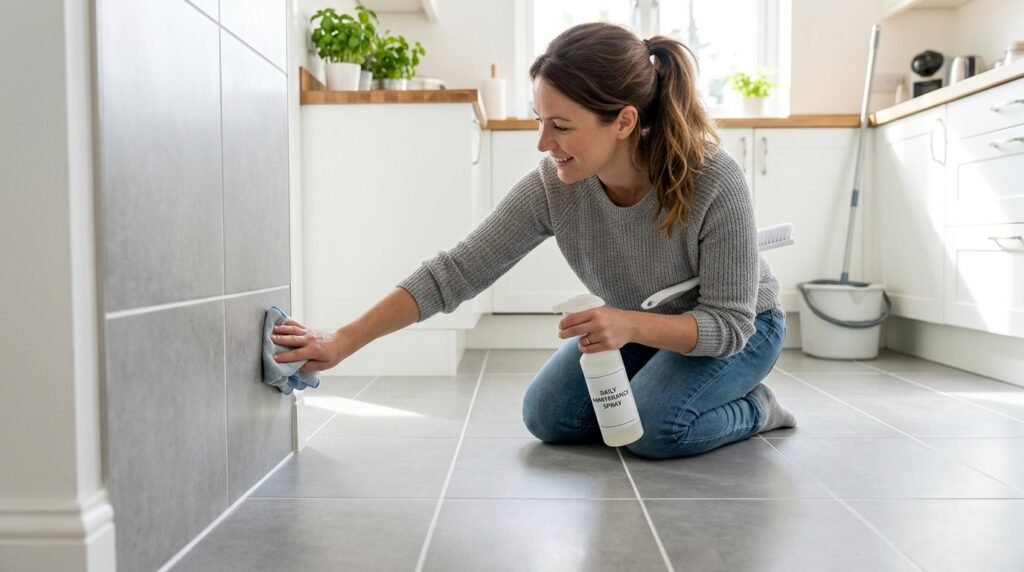
To keep grout cleaning after professional cleaning, remove loose dirt regularly, wipe spills before they sit, use a cleaner suited to your tile and grout, rinse away cleaning residue, and control grease or moisture in problem areas. Avoid harsh acids and oily or waxy products as routine cleaners. In entry areas, mats can reduce the amount of grit tracked onto the floor.
Good grout maintenance after cleaning does not require aggressive scrubbing every week. The goal is to prevent everyday soil from building up again while protecting the tile and grout from unnecessary chemicals.
Professional cleaning gives you a cleaner starting point. What you do afterward helps preserve that result.
Start With Simple Dry Soil Removal
Loose dirt should be removed before it becomes mixed with water, grease, or cleaning solution.
On tiled floors, dust, hair, crumbs, grit, and tracked-in soil can settle along grout joints. Regular sweeping or vacuuming removes much of this material without introducing chemicals or moisture.
Pay extra attention to entrances, kitchens, hallways, mudrooms, and other busy tiled areas. These spaces usually collect loose soil faster than low-traffic rooms.
Use a vacuum attachment or floor setting that is suitable for hard surfaces. Avoid tools that can scratch the tile finish.
This basic step is one of the easiest ways to keep grout from getting dirty between deeper cleanings.
Use the Right Cleaner for Your Tile and Grout
The best routine cleaner depends on the type of tile, grout, and existing treatment.
For many ceramic, porcelain, and grout installations, a neutral-pH product designed for tile and grout can be suitable for routine care. MAPEI, for example, recommends neutral-pH cleaners for regular maintenance of many tile and cement-based grout surfaces.
However, do not assume one product is safe for every tiled surface.
Natural stone, specialty tile, epoxy grout, cement-based grout, sealers, and other materials can have different care requirements. Check the tile or grout manufacturer’s instructions when they are available.
The goal is not to find the strongest cleaner. It is to use enough cleaning power for the soil without exposing the floor to unnecessary chemicals.
Do Not Leave Cleaner Residue Behind
A floor can look clean while still having cleaning product left on its surface.
That residue can make grout maintenance harder.
The Tile Council of North America notes that even suitable cleaners may leave a sticky film when they are not rinsed properly. That film can attract new dirt to grout joints.
Use the amount of cleaner directed on the product label. More solution does not automatically give a better result.
After cleaning, rinse when the product directions require it and remove the dirty water rather than letting it dry back onto the floor.
This is especially important when learning how to maintain clean grout after a professional service. Repeated layers of cleaner can slowly undo the clean appearance you are trying to protect.
Wipe Up Spills Early
A fresh spill is usually easier to deal with than one that has been left on the floor.
Blot or wipe up food, drinks, dirty water, and other spills as soon as practical. Then clean the area with a product appropriate for the tile and grout.
This matters around grout joints because many traditional cement-based grouts are porous. TCNA explains that cementitious grout can absorb staining materials.
Do not compensate for an old spill by immediately reaching for a strong acid or abrasive product.
Start with the normal care method recommended for the surface. If discoloration remains after ordinary cleaning, the problem may require a different treatment.
Fast cleanup is simpler and gentler than repeatedly attacking a set stain later.
Keep Kitchen Grout Free of Greasy Film
Kitchen floors need a slightly different maintenance approach because cooking can introduce oily soil.
Grease can settle near cooking areas, around islands, and in paths between the stove, sink, refrigerator, and dining space. Once oily material combines with dry dirt, routine mopping can become less effective.
Clean cooking splashes and greasy areas before they spread across a larger section of flooring.
Use a tile-and-grout cleaner suitable for the surface and the type of soil. Some situations may require a cleaner with more grease-cutting ability, but it still needs to be compatible with the tile and grout.
Rinse as directed so the grease and cleaner are removed instead of redistributed.
This targeted approach is better than using a heavy-duty chemical over the whole floor whenever one small kitchen section needs attention.
Manage Moisture in Bathroom Areas
Bathroom grout care should focus on keeping surfaces clean and allowing wet areas to dry.
After showers or baths, normal ventilation can help moisture leave the room. Use the bathroom exhaust fan when available, and avoid leaving standing water on tiled floors.
Wipe up water that regularly collects around tubs, showers, sinks, or other wet areas.
Routine surface care is different from trying to repair an active water problem.
If water is entering through damaged grout, failed caulk, plumbing, or another part of the tile assembly, cleaning alone will not fix it. The source should be inspected and corrected.
For normal bathroom maintenance, the goal is much simpler: remove ordinary soil, avoid persistent surface moisture, and use products suited to the installed materials.
Use Entry Mats to Reduce Tracked-In Soil
Entryways are one of the easiest places to prevent dirt before it reaches the grout.
A well-placed mat can catch grit, dust, moisture, and outdoor material near the door. Clean the mat regularly so it does not become another source of dirt.
This can be particularly useful for grout maintenance in Aurora, CO, where entry floors can deal with dry outdoor soil as well as wet shoes during changing weather.
The mat should not trap moisture against a surface that needs to dry, and it should be appropriate for the flooring underneath.
Also clean the floor immediately around the mat. Dirt often collects along its edges, where foot traffic pushes it into nearby grout joints.
Reducing tracked-in material means there is less soil to remove later.
Avoid Routine Vinegar Cleaning on Grout
Vinegar is often suggested as a universal household cleaner, but it is not a good default maintenance product for every tile-and-grout installation.
Vinegar is acidic.
TCNA explains that cement-based grout is alkaline and can be affected by acids. It advises against relying on acidic cleaning as ordinary grout care.
MAPEI similarly advises that regular vinegar use can weaken or discolor cementitious grout and notes that acids can also etch some natural stone surfaces.
That does not mean every cleaning problem requires a neutral product. Specialty problems sometimes need specialty chemistry.
It means homeowners should not use a universal vinegar recipe on an unknown tile-and-grout installation simply because it is common household advice.
Avoid Oily and Waxy Cleaners on Grout
Some cleaning products can leave more behind than you expect.
TCNA advises against oil- and wax-based cleaners on cementitious grout because these products can leave a film within the grout surface.
A product that makes tile appear shiny immediately after mopping may not be the best choice if it leaves residue in the joints.
For routine grout cleaning maintenance, focus on removing soil rather than adding a coating unless the product is specifically intended for your installed surface.
If the floor starts to feel sticky or seems to collect dirt quickly after mopping, review the cleaner being used, its dilution, and the rinsing directions.
Changing the maintenance product may be more useful than increasing scrubbing.
Do Not Scrub Grout More Aggressively Than Necessary
More pressure does not always mean cleaner grout.
Repeated aggressive scrubbing can be unnecessary, especially when the actual issue is incorrect cleaner selection or residue that has not been rinsed away.
Start with a cleaner suitable for the surface and enough agitation to loosen ordinary soil.
If a soft or moderately firm grout-safe brush is appropriate according to the product and surface instructions, use controlled pressure rather than attacking the joint.
Stop if the grout begins to crumble, powder, or show physical damage.
A damaged joint is not a cleaning problem.
The objective after professional cleaning is preservation. Routine care should remove new soil without repeatedly wearing at the grout itself.
Keep Cleaning Water Clean
When mopping a larger tiled floor, dirty water can work against you.
If the same heavily soiled water is moved across every room, some suspended dirt can end up back on the floor.
Change the water when it becomes dirty and follow the cleaner’s dilution and rinsing directions.
The same principle applies to cloths and mop heads. A dirty cleaning tool cannot continue removing soil effectively.
TCNA recommends removing dirty solution from grout and rinsing away remaining cleaner rather than allowing contaminated water or soap film to remain in the joints.
Good grout maintenance after cleaning is often less about using stronger chemistry and more about removing the dirty solution properly.
Give Kitchens, Bathrooms, and Entryways Different Care
Not every tiled room needs the same maintenance.
Kitchen grout often needs attention to greasy soil and food spills. Bathrooms need surface cleaning plus moisture control. Entry areas need frequent dry soil removal and protection from tracked-in grit.
A low-use tiled guest room may need much less attention.
Base your routine on what actually reaches the floor.
A practical maintenance routine can include regular dry soil removal, prompt spill cleanup, suitable damp cleaning when needed, attention to busy areas, and occasional checks for residue or physical grout damage.
There is no reason to aggressively deep clean every grout joint simply because a certain date appears on the calendar.
What If Grout Starts Looking Dark Again?
First, clean the area with the routine method that is appropriate for the surface.
Check whether loose soil, kitchen grease, soap film, or cleaner residue can be removed without stronger treatment.
Do not immediately switch to harsh chemicals.
If the same sections repeatedly change appearance despite reasonable care, the next step is to identify the condition rather than continuing to add new products.
Steamrite’s guide explaining why grout can get dirty again after cleaning covers that separate problem in more detail.
For this maintenance guide, the important point is simple: when normal care stops working, diagnose the problem before making the cleaning routine more aggressive.
When Is Routine Grout Maintenance No Longer Enough?
Home maintenance is useful for ordinary surface soil. It becomes less effective when dirt has become deeply embedded or when the grout has a condition that household cleaning cannot correct.
Consider a deeper assessment when grout remains heavily discolored after suitable cleaning, large high-traffic areas no longer respond to normal maintenance, greasy buildup has become difficult to remove, or old cleaner residue covers a significant area.
Physical damage is another reason to stop treating the issue as ordinary cleaning.
Loose, cracked, missing, or deteriorating grout may need repair rather than stronger cleaner.
When embedded soil has moved beyond routine care, professional tile and grout cleaning in Aurora, CO uses inspection, cleaning solutions, scrubbing, and extraction to address built-up grime.
Grout Maintenance for Aurora Homes
The best Aurora tile and grout care routine starts at the places where dirt enters or collects.
Keep mats clean at exterior doors. Remove loose grit from tiled entries before wet cleaning. Wipe kitchen spills early, and keep bathroom floors from holding unnecessary standing water.
Use cleaning products based on the actual tile and grout rather than choosing a product simply because it is labeled “heavy duty.”
Aurora homeowners also do not need a completely different chemical routine for each season. The more useful approach is to watch how the floor is being used.
If an entryway gets dirty faster during periods of wet or dusty foot traffic, clean that area more often instead of unnecessarily treating the entire tiled floor.
Final Thoughts
Learning how to keep grout clean after professional cleaning is mostly about preventing ordinary soil from building up again.
Remove loose dirt before mopping, wipe spills early, control grease in kitchens, manage surface moisture in bathrooms, keep entry mats clean, and use cleaning products that match the tile and grout. Just as important, remove cleaning residue instead of letting it dry in the joints.
Avoid treating stronger chemicals as the answer to every problem. Consistent, surface-appropriate grout maintenance after cleaning is usually more useful than aggressive scrubbing.
When routine maintenance can no longer remove embedded buildup, a tile and grout cleaning estimate in Aurora can help determine whether the floor needs another professional cleaning or a different type of attention.
FAQs
How do you keep grout clean after professional cleaning?
To keep grout clean, remove loose dirt regularly, clean spills early, use a cleaner suited to the tile and grout, rinse away cleaner residue, and give extra attention to kitchens, bathrooms, and entry areas.
Is a pH-neutral cleaner good for grout?
A neutral-pH cleaner can be suitable for routine maintenance on many ceramic, porcelain, and cement-based grout installations. Always check the tile, grout, or cleaning-product manufacturer’s directions because not every surface has the same requirements.
Should I use vinegar to maintain clean grout?
Vinegar should not be treated as a universal routine grout cleaner. Its acidity can affect cement-based grout and some natural stone surfaces when used regularly.
Why should cleaning solution be rinsed from grout?
Cleaner left behind can form residue. TCNA notes that sticky soap film can attract dirt, so proper rinsing or removal of dirty cleaning solution is an important part of grout care.
How should I maintain kitchen grout?
Remove food spills quickly, control greasy buildup near cooking areas, remove loose dirt before wet cleaning, and use a cleaner suited to the tile, grout, and soil.
How should I care for bathroom grout?
Keep the surface clean, wipe up standing water, use normal bathroom ventilation, and follow care instructions for the installed tile and grout. A persistent water problem should be repaired rather than treated only with cleaner.
Do entry mats help keep grout clean?
Yes. Entry mats can reduce the amount of grit, dirt, and moisture carried onto tiled floors. Keep the mat itself clean and remove soil that collects around its edges.
When should grout be professionally cleaned again?
There is no single maintenance date that fits every floor. If appropriate routine cleaning no longer removes embedded soil or large areas remain heavily discolored, the floor may need professional assessment.